


Welcome back to the we.digitize blog! Here, we regularly keep you updated on the latest developments and provide insights into exciting topics related to our company and the industry. In this post, we’ll take a closer look at the powerline technology we use at LiveCharger.
What is Powerline Communication (PLC)?
Powerline is a communication technology that transmits data over existing electrical wiring. In this process, high-frequency data signals are transmitted over the same lines as the electrical current, eliminating the need for separate data cabling.
While powerline technology is often used in residential settings to expand a home network, it also plays an important role in electric mobility. In this context, its primary purpose is not to transmit the Internet, but rather to enable communication between electric vehicles and the charging infrastructure. This allows energy and data to be transmitted simultaneously over the same connection.
Compared to separate network cabling, Powerline reduces installation effort and makes efficient use of the existing infrastructure. Unlike Wi-Fi, data is transmitted via a wired connection, which makes it significantly more secure than Wi-Fi, since not everyone can pick up the signal.
How does Powerline work?
In electric mobility, Powerline enables data exchange between the vehicle and the charging station while the charging cable transmits energy. Before charging begins, important information - such as maximum charging power, safety parameters, and Plug & Charge authentication - is exchanged. Continuous communication also takes place during the charging process to ensure safe and efficient operation.
Technically, Powerline works by superimposing high-frequency data signals onto the existing alternating or direct current signal on the line. Both signals use the same cable but differ significantly in frequency. While power is transmitted at comparatively low frequencies, the data is modulated onto a higher-frequency carrier. If the power line initially carries a low-frequency electrical voltage, for example, 230 V at 50 Hz in the AC grid, the higher-frequency signal is then modulated onto the line for data transmission.
To put it simply, the power signal plus the data signal equals the total signal on the line:
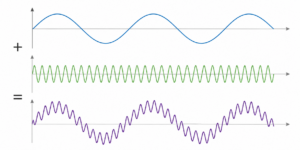
The PLC signal is then superimposed on the existing line voltage. This allows both signals to be transmitted over the same conductors. The amplitude of the data signal is significantly smaller than that of the line voltage. The data signal therefore only slightly alters the energy superposition. On the receiving end, the higher-frequency signal can be filtered out of the total signal using filters and signal processing and then processed as digital information.
Why is powerline technology used in electric mobility?
As the adoption of electric vehicles increases, so do the demands on the charging infrastructure. Modern charging processes require more than just the transfer of energy. Vehicles and charging stations must continuously exchange information. Powerline offers a reliable solution for this, as both energy and data can be transmitted over the same connection. This reduces the amount of cabling required while ensuring secure and stable communication. In the AC sector, this form of communication has been less common to date. Here, communication between the vehicle and the charging station takes place via the so-called Control-Pilot (CP) line. However, with the increasing adoption of ISO 15118, Powerline communication is also being used more and more for AC charging.
Powerline also provides the technical foundation for smart features such as Plug & Charge in accordance with ISO 15118, dynamic load management, and future smart grid applications. The technology thus plays a key role in making charging processes more convenient and efficient.
You'll learn how we use Powerline at LiveCharger later in this article.
The Benefits of Powerline
Powerline offers numerous advantages for modern charging infrastructure:
- Less wiring required: Power and data are transmitted over the same line, eliminating the need for additional communication cables.
- Easy integration: New charging points can be easily integrated into existing systems, making them ideal for modular busbar solutions.
- Reliable Communication: Wired data transmission is reliable and significantly more secure than wireless solutions.
- High scalability: Powerline is suitable for both small-scale charging installations and large charging stations.
- Support for smart charging features: The technology enables advanced features such as load management, Plug & Charge, and communication with energy management systems.
- Future security: Powerline is an established component of modern charging systems and supports the ongoing digitization of electric mobility.
ISO 15118
The international standard ISO 15118 plays an important role in this regard. It defines how electric vehicles and charging equipment communicate with each other and ensures that vehicles and charging stations from different manufacturers can work together without complications. Communication takes place via powerline within the charging cable.
ISO 15118 serves as the basis for numerous smart features, such as:
- Smart Load Management: The optimal distribution of available power across multiple charging points.
- Plug & Charge: Automatic authentication and starting the charging process without an RFID card or an app.
- Smart Charging: Adjusting the charging process based on electricity prices or grid load.
- Bidirectional charging (V2G): The feeding of energy from the vehicle back into the power grid or a building.
Applications in Busbars and Charging Infrastructure
In the charging infrastructure, we also rely on Powerline for our LiveCharger product to enable reliable data communication within the system. This approach uses existing power lines not only for power delivery but also for data transmission. As a result, additional communication lines are not required in many use cases.
A key advantage of our power rail is the high degree of flexibility it offers when planning and expanding charging infrastructure. Especially at the start of a project, it’s often impossible to predict how many charging points will be needed in the long term. With conventional installations, expansions require additional civil engineering and cabling work, which takes time and incurs costs. For this reason, we work with Powerline to save our customers these expenses. This allows additional charging points to be easily integrated as demand increases, providing planning certainty. This works best with modular busbar solutions like the ones we offer, since they eliminate the need for additional cabling.
To implement powerline communication in our projects, we rely on devolo products, which enable stable data transmission between the charging points and the load management system. This process is possible in both single-phase and multi-phase installations.
Our Case Studies
We have already implemented several projects in which Powerline has been used successfully. Below, we present three of these projects and show how Powerline was used in each case to address specific challenges and concepts.
One example is the project at duisport dlps. There, Powerline was used as part of the communications infrastructure. In addition, a load management system was integrated to efficiently distribute the available power among the charging points.
A particular challenge was the physical distance between the AC charging stations, the DC charging stations, and the transformer. The building’s network connection was therefore established via fiber optics, while the communication link between the transformer and the DC charging stations was implemented using powerline communication.
This made it possible to avoid additional construction work and further civil engineering costs.

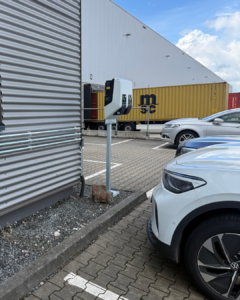
Another project was implemented at Wagner GmbH. Here, too, the DC charging stations were connected via the existing busbar using Powerline. The charging stations are linked to the vaylens backend, allowing them to be centrally monitored and managed.
In addition, a dynamic load management system is used that takes both AC and DC charging points into account simultaneously and controls the available power accordingly.
Powerline technology also forms the basis of the communications infrastructure in this project. It is used to connect both AC and DC charging stations and enables communication over the existing infrastructure.
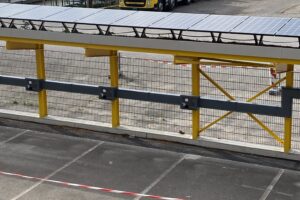
Powerline technology is also in use at our own headquarters, W+A in Kerzers, Switzerland, as part of the charging infrastructure.
What makes this project truly unique is its combination of various sustainable technologies. The charging infrastructure is integrated with a photovoltaic system and a canopy, the roof of which has also been greened. In this way, the project combines modern charging infrastructure with renewable energy and a sustainably designed environment. This project also demonstrates how flexibly Powerline can be integrated into various infrastructure concepts.
Conclusion & Outlook
Powerline technology plays a major role in the field of electric mobility.
If you have any questions about Powerline or are interested in our power rail solution, you can reach us at any time at info@we-digitize.io. We would be happy to discuss options for expanding your electrical infrastructure with you and work with you to design a customized solution.
Thank you for taking the time to read our article.
You can gain further insights into our projects on our social media channels Instagram and LinkedIn .
Stay tuned!